
Eyewear Frame Surface Treatment 2026: How to Specify Acetate Polishing, Metal Anodising and PVD Quality in OEM Orders
- SCM

- Apr 16
- 2 min read

Surface treatment is one of the least discussed but most commercially important aspects of eyewear frame manufacturing. The finish on a frame — whether acetate polishing, metal anodising, titanium PVD coating, or TR90 surface treatment — determines its visual appeal, durability, and ultimately whether it justifies its retail price point. For international buyers sourcing frames from China, understanding what each surface treatment involves and what quality standards to specify is as important as the frame design itself.
Acetate: Barrel Polishing and the Quality Indicators
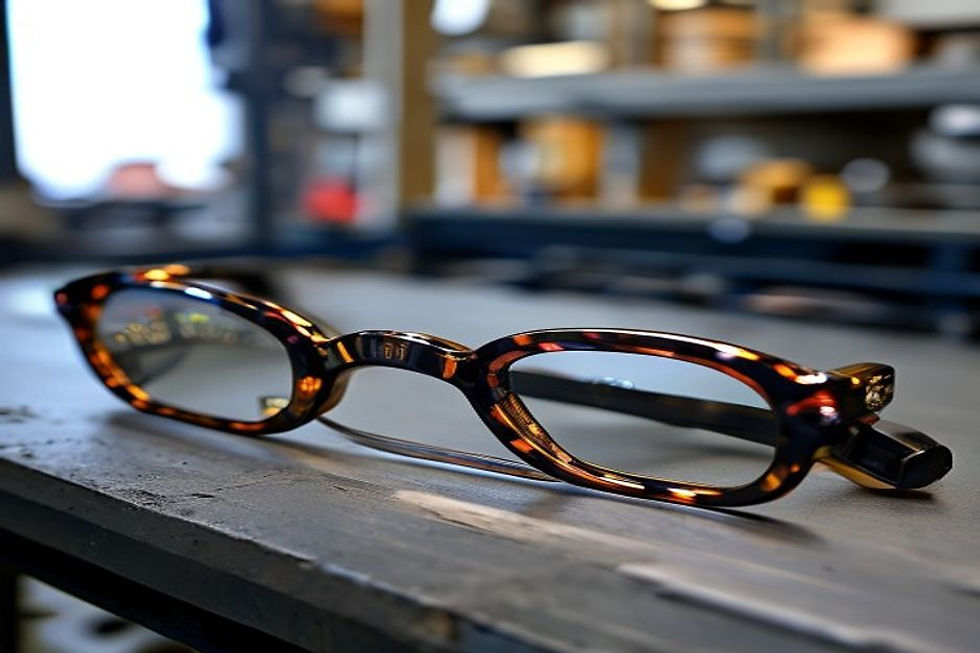
Acetate frames achieve their characteristic high-gloss surface through barrel polishing — a multi-stage abrasive tumbling process using progressively finer cutting and polishing media over 4 to 8 hours per stage. Premium acetate polishing involves 3 to 4 barrel polishing stages, followed by hand polishing of the lens rim edges and temple tips. The quality indicator buyers can verify without laboratory equipment is the lens rim edge: on properly polished premium acetate, the edge should be fully transparent with no visible machining marks under 10x magnification. A frosted or opaque lens rim edge indicates incomplete barrel polishing, typically from cutting 2 to 3 hours off the polishing cycle to reduce cost. This shortcut is extremely common in mid-tier Chinese acetate production and is the single most reliable indicator of polishing quality compromise.
Metal and Titanium: Anodising vs PVD Coating
Metal eyewear frames receive colour and surface protection through either anodising or PVD (physical vapour deposition) coating. Anodising is an electrochemical process that creates a hard oxide layer on the frame surface — it is integral to the metal, not a coating applied on top. Anodised surfaces have excellent abrasion resistance and typically pass 50 to 100 hour salt spray testing per ISO 9227. PVD coating deposits a thin metallic or ceramic layer (typically titanium nitride for gold colours, chromium nitride for silver/chrome) in a vacuum chamber. PVD-coated frames achieve superior colour uniformity and a wider colour palette than anodising, but the coating thickness (typically 0.3 to 1.5 microns) must be sufficient to pass scratch resistance and corrosion testing.

Specifying Surface Treatment Quality in OEM Orders
For OEM buyers, surface treatment quality must be specified in the purchase contract, not left to factory interpretation. The minimum specification elements for acetate frames are: polishing stages (minimum 3 barrel stages + hand polish), gloss level (specify 85+ GU at 60 degrees per ISO 2813), and colour delta (maximum ΔE 1.5 vs approved colour sample per CIE Lab). For metal and titanium frames: coating type (anodise or PVD), colour reference (Pantone or approved physical sample), adhesion test pass/fail (cross-cut test per ISO 2409), and salt spray hours (minimum 48h per ISO 9227 for standard optical, 96h for sports/outdoor applications). SCM Group provides surface treatment specification templates and pre-shipment QC inspection for all eyewear OEM programmes. Contact scmgroup@scmgroup.online or WhatsApp +86-198-7525-3287.



Comments